Home About
Downloads Devices Home About
Downloads Devices
Home About
Downloads Devices Home About
Downloads Devices|
|
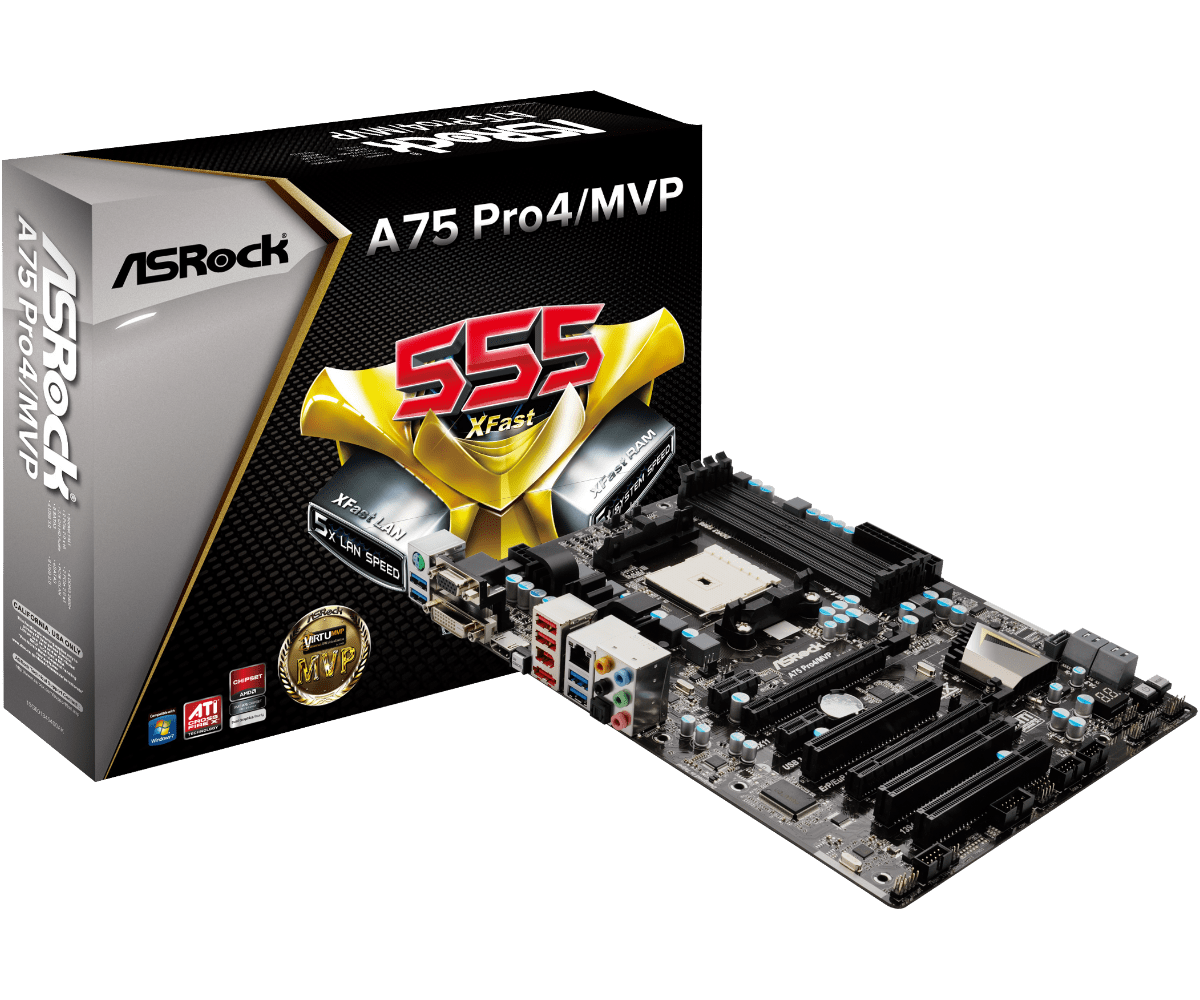
ASRock A75
Pro4/MVP |
Motherboard Downloads |
Released around 2012, this motherboard
is about 10 years old now, although at first glance you may not know
that. The board has a fairly sleek, understated design. It uses a
dark brown PCB, with mainly black parts. The exception being the CPU
socket, capacitors, chipset heatsink, rear I/O, built-in buttons, and
SATA ports. Most of these are silver or gray, which still blends in
pretty well. There are no LEDs on the motherboard, or any headers for
them, aside from the power LEDs.
Moving away from aesthetics,
the board supports FM1 CPUs and APUs, along with DDR3 1866, or
2400+OC according to ASRock. The CPU is this biggest limiting factor
for this board, given they are based on the K10 design, and come in
quad-cores on the high end. These CPUs are over 10 years old at this
point, and just wont keep up with many modern workloads. That does
not mean they are useless, just not ideal. Most likely, the 32GB RAM
limitation is not going to be an issue for most people, and neither
is the older PCIe 2 when you consider the CPUs you can run.
What
holds up pretty well is the rear I/O. Given the 4 USB3 ports, HDMI,
7.1 audio, gigabit Ethernet, and eSATA, you could be forgiven for
thinking this is a much newer board than it is. There are no ports
here that can not be found on newer boards, aside from the VGA, which
is hard to come by, but not impossible. There is also DVI, 1 PS/2
mouse and keyboard port, SPDIF, FireWire400, 2 USB2 ports, and a
clear CMOS button packed into the back too. The port selection is
pretty nice, but I would have liked to see 2 or more extra USB ports
added.
Where the board lets down a little is the front
expansion. There are 3 USB headers, giving 6 USB ports for the front,
but they are only USB2. This can be excused for the time though, as
there were still may boards with only 2 USB3 ports on the rear, if
any at all. The chipset itself is limited to 4 USB3 ports anyway, and
while some may have preferred 2 USB3 in the rear and 2 USB3 in the
front, I can't fault ASRock for putting them all on the rear.
There
are also 5 SATA3 6Gb/s ports, which is still standard on many boards
today. The newer boards usually have m.2 as well, but that is not as
common as SATA yet, so for many people, this is not a problem.
The
board also supports crossfire, although I really doubt that would
make any sense today. It does have a debug LED, built in power and
reset buttons, and that clear CMOS button, which are nice to haves.
There are also 2 4pin fan headers (one for the CPU), and 4 3pin fan
headers (one also for the CPU), which is a welcome addition.
For
software, this board officially supports Windows XP, Vista, and 7.
That's it. Windows 8, 8.1, and 10 should run without any major
issues, and 11 could probably run if you try hard enough too. Linux
should work without problems, and would probably be the best bet
anyway, given the hardware. If you run Windows on this, you do have
access to the ASRock Extreme Tuning utility, which I find quite nice.
It seems to have a pretty good interface and feature set, especially
for an FM1 platform board from 2012, but it does look a little dated
by today's standards.
The UEFI BIOS is another win
for this board in my book. It again, looks a little dated, but aside
from that, is not bad. It has a great layout and many options too.
The overclocking is easy, the fan adjustment is a breeze (pun
intended), monitoring is also great. I really don't have much bad to
say about the BIOS.
To conclude this mini essay of a review,
for the time, this board seems to be a mid to high end FM1 board. At
roughly 90 USD in 2012, it sure wasn't the cheapest option. It looks
nice, and seems to use high quality parts too. Solid state caps,
among other things, show its a higher end board. While I wouldn't
recommend you go out and get one of these boards for your next build,
if you come across one for cheap, I think it is still a solid board.
Just don't expect it to play the latest games, or do too much heavy
lifting. 9/10 in my book.
| Rear I/O | Headers | |||
| FireWire 400 | 1 | IR | 2 | |
| eSATA | 1 | COM | 1 | |
| USB 2 | 2 | SPDIF | 1 | |
| USB 3 | 4 | HD Audio | 1 | |
| Gigabit Ethernet | 1 | USB2 | 3 | |
| VGA | 1 | PWRLED | 2 | |
| DVI | 1 | |||
| HDMI | 1 | Internal Con | ||
| 3.5MM | 5 | |||
| SPDIF | 1 | 24PIN | 1 | |
| 8PIN | 1 | |||
| Features | AMD FM1 | 1 | ||
| DDR3 Slots | 4 | |||
| Crossfire | 1 | SATA6GB | 5 | |
| Hybrid | 1 | PCI | 3 | |
| MISC | DEBUG LED | PCIe X1 | 2 |